


About Khadi
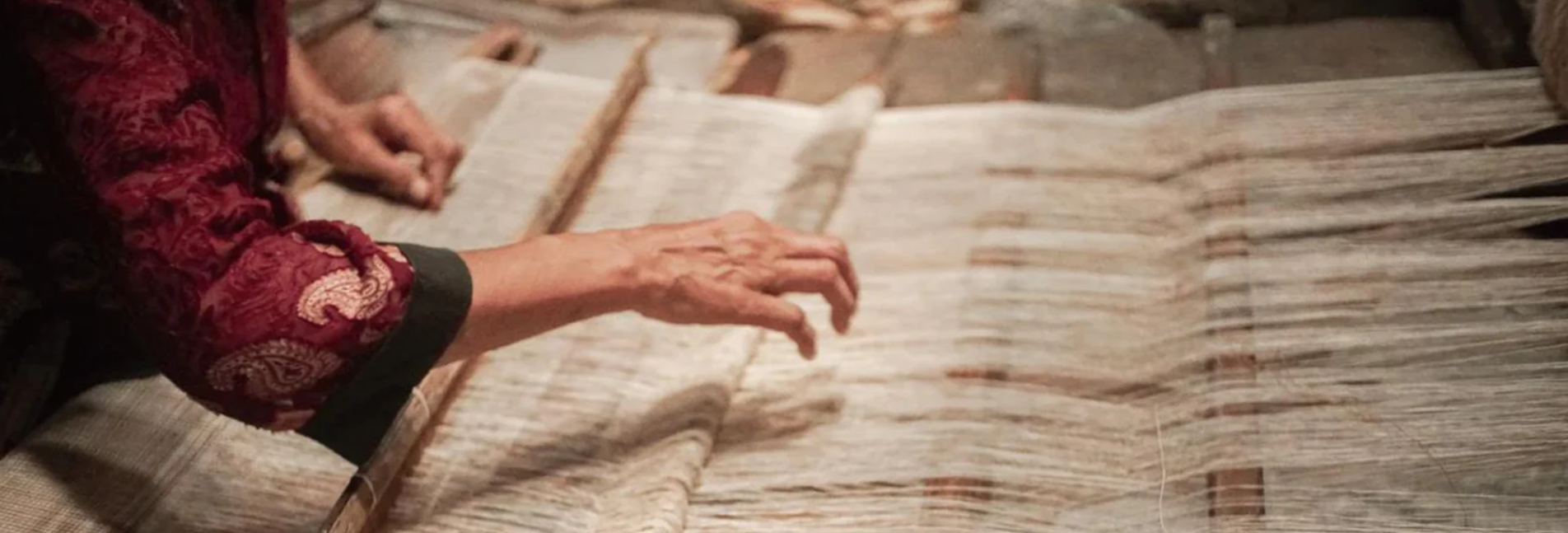
Khadi, also known as "The Fabric of Freedom," holds immense cultural, historical, and economic significance in India. It is not just a textile but a movement that represents self-reliance, sustainability, and resistance against colonial oppression. It was popularized by Mahatma Gandhi during the Swadeshi Movement as a means to boycott British goods and promote local production. The charkha, or spinning wheel, became a symbol of India's resistance against British rule and an emblem of economic independence.
Khadi production has had a profound impact on rural economies, by providing livelihoods to thousands of Spinners, Weavers and Other associated artisans. It empowers women, who form a significant portion of the workforce in this industry.
Khadi stands out as an eco-friendly alternative in an era of fast fashion and environmental degradation. The production process is hand-driven and requires minimal energy, resulting in lower carbon emissions with no industrial waste. The use of natural dyes and organic fibers further enhances its eco-conscious appeal.
Mahatma Gandhi associated khadi with moral values like simplicity, humility and communal harmony. He saw khadi as a unifying force that transcended caste, class, and regional divides.
Khadi is a symbol of pride and identity. It represents not only India's rich heritage and craftsmanship but also continues to hold relevance in today's world.
it is more than just a cloth—it is a philosophy.
Overview
Khadi is a versatile fabric. It has the unique property of keeping the wearer warm in winter as well as cool in summer season. This fabric has coarse texture and gets easily crumpled, therefore in order to keep it firm and stiff, starch is to be added. This fabric on washing is more enhanced thus the more you wash it, better the look. Khadi is not easily worn out for years together, at least for 4-5 years. Very attractive and designer apparel are made by doing handwork on them garments made from it. Khadi spinning is generally done by girls and women and weaving mostly by men. During spinning of Khadi the threads are interwoven in such a manner that it provides passage of air circulation in the fabric. Apart from this unique property, it also provides warmth in winter season which is quite surprising factor. Khadi cotton is required to be starched so that it does not get easily crumpled. It comes in many colors and is not harmful to the skin as synthetic fabrics. This cotton is very soothing in summer season as ample amount of air ventilation is there, it has the capacity to absorb moisture therefore it easily soaks the sweat and keeps the wearer cool and dry. Khadi cotton comes in plain as well as in printed fabrics.
The most common outfit of made from Khadi cotton is the'Kurta'. Many types of apparel are manufactured from Khadi cotton like saris, salwar suits, fabric yarns, western tops, shirts, trousers, skirts, handkerchief,etc. It is a very durable fabric. In Khadi silk, the ratio of Khadi and silk fabric is 50:50. This fabric requires dry cleaning. It shrinks about 3% after the first wash. It is quite an expensive fabric. Khadi silk provides a royal and rich look. The various types of apparels made from Khadi silk are salwar kameez, kurta pajama, saris, dupattas, shirts, vest and jackets. Apparels like kurta, jacket, sari blouses requires lining to be given to ensure its longetivity.
Previously Khadi was dyed in earthy color tones and was used to make traditional garments but now designers are experimenting by dyeing Khadi with striking colors like limegreen, violet, baby pink, turquoise blue, etc. Stylish garments like mini skirts, halter neck tops, racer tops, tunics, etc are made from Khadi. Khadi is hand woven and hand spun fabric which takes time to be made. It is mainly manufactured in rural areas of India. In previous times it was considered as the fabric for the poor rural workers & farmers. But wearing Khadi is no more for the poor, many high profile personalities and economically sound people prefer to wear it. It is considered as one of the most beautiful Indian fabric. The Khadi wearer gets a royal and distinguishable look due to its fall and style. It symbolizes luxury and uniqueness.
Government Policies
Khadi and village industries commission' is the Indian government body which promotes the usage of Khadi. Khadi production and selling comes under the small scale industry sector. This government body was created by an act which was passed by the Parliament. This gave a boost to the Khadi manufacturing sector of India, as a result many new outlets of Khadi gramodyog opened all over the country. These shops sell stitched as well as unstitched Khadi fabrics. Every year starting from the date- 3rd October to January 29th all Khadi gramodyog bhavans provide discount to the public on various Khadi products. It comes under the category of Indian handloom. This sector also generates employment for the rural population of India. Indian government conducts various exhibitions and trade fairs in India and abroad to promote this fabric. The small scale industries engaged in manufacturing of Khadi gets economic redemption for the raw materials and production costs by Indian government. According to a recent survey done it provides employment to 14.97 lakhs of people, the total annual production of Khadi is 111.49 million sq. mtrs.
Khadi over the decades has moved from a freedom fighter's identity fabric to a fashion garment. Today there is such an increasing demand for Khadi that despite of the thousands of workers involved in spinning and producing Khadi fabric, the demand of the market does not gets fulfilled.
